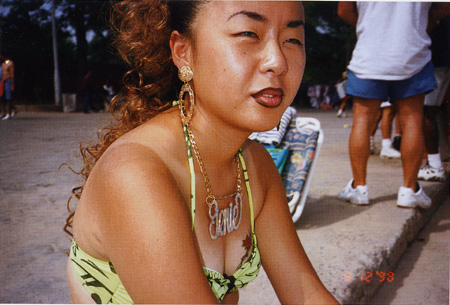
The Hispanic Project (1), 1998
After observing particular subcultures and ethnic groups, Nikki S. Lee adopts their general style and attitude through dress, gesture, and posture, and then approaches the group in her new guise. She introduces herself as an artist (though not everyone believes her or takes it seriously), and then spends several weeks participating in the group’s routine activities and social events while a friend or member of the group photographs her with an ordinary automatic “snapshot” camera. Lee maintains control of the final image, however, insofar as she chooses when to ask for a picture and edits what photographs will eventually be displayed.

The Hip Hop Project (1), 2001

The Seniors Project (15), 1999
From schoolgirl to senior citizen, punk to yuppie, rural white American to urban Hispanic, Lee’s personas traverse age, lifestyle, and culture. Part sociologist and part performance artist, Lee infiltrates these groups so convincingly that in individual photographs it is difficult to distinguish her from the crowd. However, when photographs from the projects are grouped together, it is Lee’s own Korean ethnicity, drawn like a thread through each scenario, which reveals her subtle ruse.
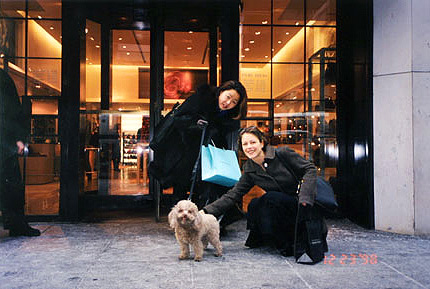
The Yuppie Project (4), 1998

The Ohio Project (8), 1999
Lee’s success with these projects depends heavily on the appearance of the final photographic record. Her use of the snapshot aesthetic is partly what convinces us that she belongs—along with her uncanny ability to strike the right pose. The electronic date stamp in the corner confers scientific specificity and authenticity, while at the same time marking the picture as candid and familiar, the work of an unassuming amateur. Indeed, sometimes they are exhibited as drug-store prints push-pinned to the wall. Exhibited as enlarged, framed works of art in a museum context, however, the photographs reveal the conceptual foundation of Lee’s projects. As a group or just mixed together, the projects support and define one another.

The Skaters Project (7), 2000
Lee’s projects propose questions regarding identity and social behavior. Do we choose our social groups consciously? How are we identified by other people? Is it possible for us to move between cultures? Lee believes that “essentially life itself is a performance. When we change our clothes to alter our appearance, the real act is the transformation of our way of expression—the outward expression of our psyche.”

The Schoolgirls Project (22), 2000
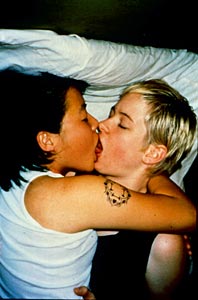
The Lesbian Project (14), 1997
Born Lee Seung-Hee in Korea in 1970, Nikki S. Lee chose her American name when she came to New York in 1994. (The friend she asked to compile a list of American names used those appearing in that month’s Vogue, thus Nikki S. Lee inadvertently named herself after another much-photographed and image-changing woman, model Niki Taylor.) As a child growing up in the small South Korean village of Kye-Chang, Lee was exposed to a variety of foreign cultures through the mediating vehicles of television, popular periodicals, and music. In spite of her isolation, she developed a certain empathy for other cultures, an ability to empathize with other people that is clearly integral to her projects now. Her work is also unmistakably informed by Asian notions of identity, where identity is not a static set of traits belonging to an individual, but something constantly changing and defined through relationships with other people.

The Swingers Project (53), 1999

The Tourist Project (24), 1997
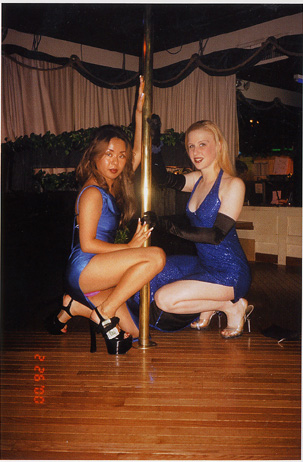
The Exotic Dancers Project # 34 2000
Questions-
- How do you think Lee's work raises questions about the nature of social identity? Do you agree withher statement that "essentially life itself is a performance?"
- How do you think Lee's images retain what the author describes as "the work of an unassuming amateur?"
- How would you compare and contrast Lee's work with the work of Richard Bellingham, from Ch. 5?

7 comments:
I think what she says is true, “essentially life itself is a performance”. We chose how other people perceive us by the way we dress, act, and relate to others. We choose what type of social identity we have. Her work comes off very much like "the work of an unassuming amateur” with the sometimes-harsh available lighting, and date on the actual photographs. But ultimately it would come down to how her work is displayed. Bellingham is about portraying the intense reality that is his subject’s lifes, but Lee is creating the reality she is capturing. It may be a real reality for some people but not for her. She is placing herself in it. I think it is a great idea.
I think the fact that she is able to infiltrate these dramatically different groups says that the nature of social identity is fairly fluid. There are rules that one must abide by to fit in a group, sure, but change your group, change your rules and you're pretty much in.
Life is what role you want to fill. There are so many people in the world and that could easily re-assign yourself in life and insert yourself into a group much like Lee has done. Her work comes off amaturish in that she doesn't actually take the photos, but lets an amateur take the photos, ona regualr point and click no less. Her work is radically different from Bellingham. Lee's work comes purely from a relationship that is short and goal oriented, get the shots you need. Bellingham has known his subjects his whole life and share a dynamic. At least in backstory.
I agree with the statement that, "essentially life itself is a performance". I found it interesting the way she put these people into specificly titled groups. The sterotypical way that they are categorized almost seems to takes away their individuality, as if their title is their only identity. What we see in the picture is the only face we know, when really, there is some much more to a person, so much untold about these peoples lives.
Do you agree withher statement that "essentially life itself is a performance?"
yes,we play roles in life, roles we learn at a very young age, that tell us how to behave.
How would you compare and contrast Lee's work with the work of Richard Bellingham, from Ch. 5?
Both artists use the same individual(s) yet, because the artist is posing herself these photos seem less spontaneous yet they retain a realism in each stereotyped culture, unlike Richard's whose photos are realistically unposed, and expose everything.
klbrown
First of all I love these projects. Her ability to becme part of each social subclture is amazing. I don't necessarily agree with her statement that life is a performance at the same time I'm not in complete disagreement. I believe that some people may put on a face for show while others simply don't give a second thought as to how pople might percieve them.
I love how Lee's photos capture reality with snapshot like photos. This is a very simple technique- and maybe there was not a good plan or idea behind it, but he does not show in her work. It looks as though she did plan out what she was looking for and found it.
Post a Comment