Rineke Dijkstra documents people in transitional moments: mothers shortly after giving birth, young people entering the military, matadors still bloody from a bullfight, young club kids just off the dance floor, and preadolescent bathers on various beaches in the United States and Eastern Europe. Formally, her images resemble classical portraiture with their frontally posed figures isolated against minimal backgrounds. Despite their uniformity, however, Dijkstra's pictures deftly expose the emotional state of her individual sitters. Although she isolates the subjects in her Beaches series (1992–96) and frames them with only sea and sky, the artist reveals much about them by capturing a subtle gesture or expression in these unguarded moments that reside somewhere between the posed and the natural. In photographing the already awkward young subjects in their bathing suits, Dijkstra sets up a situation marked by a self-consciousness that parallels the uneasy passage between childhood and adulthood.

Kolobrzeg, Poland, 1992

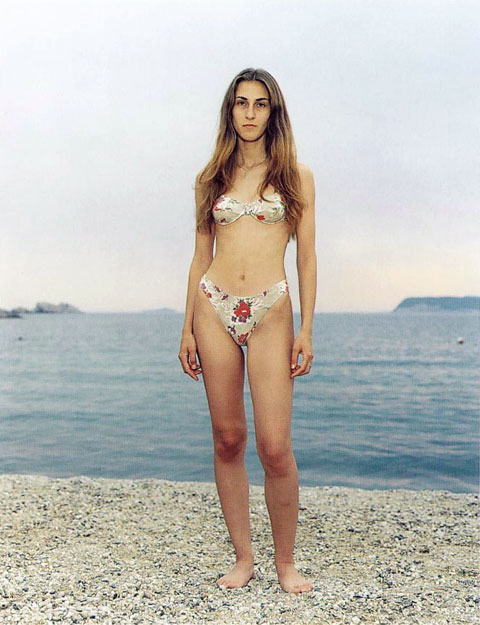
Dubrovnik, 1996
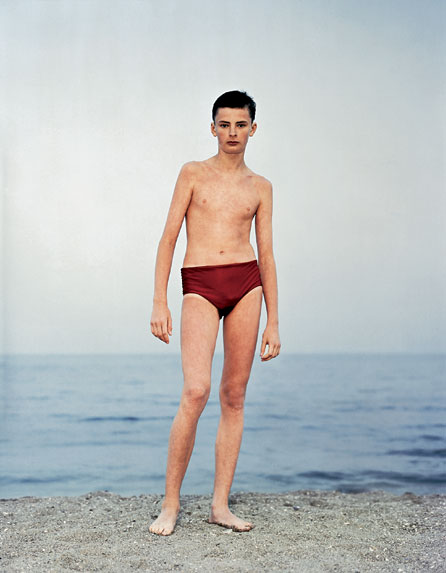
Odessa, Ukraine, August 4, 1993
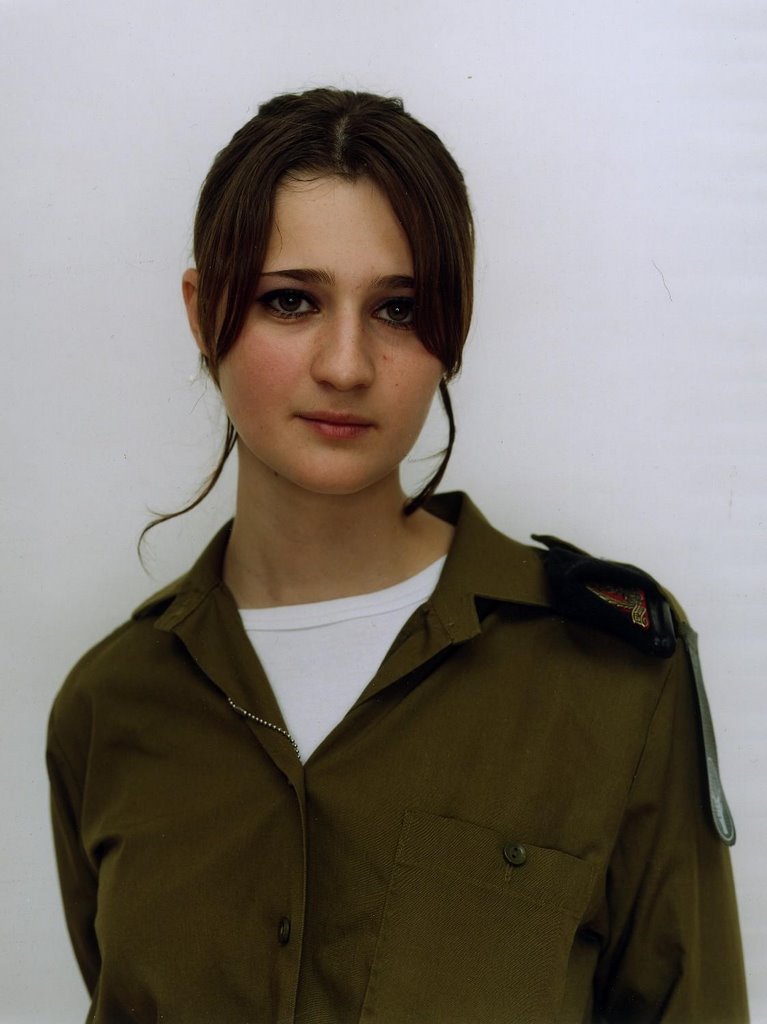
Evgenya Dec. 9. 2002
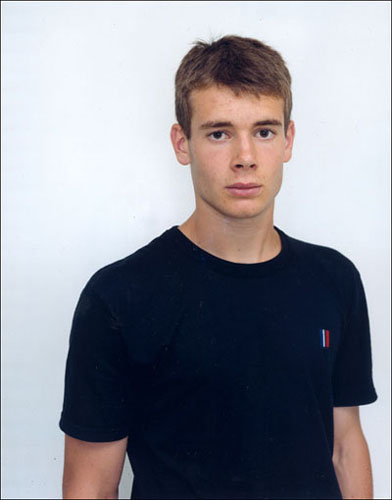
Olivier Silva, The Foreign Legion, Quartier Viénot, Marseille, France, July 21, 2000
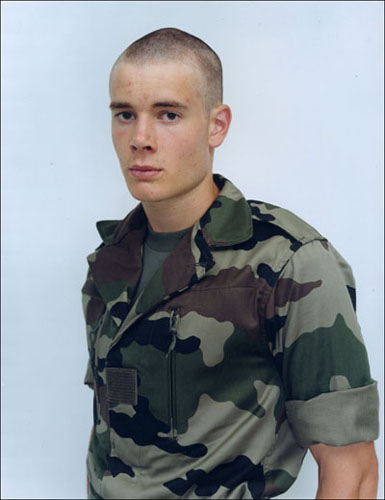
Olivier Silva, The Foreign Legion, Quartier Viénot, Marseille, France, July 21, 2000

Olivier Silva, The Foreign Legion, Les Guerdes, France, November 1, 2000

Olivier Silva, The Foreign Legion, Camp Raffalli, Calvi, France, June 18, 2001
Questions-
- Why do you think Dijkstra chooses to take such a similar approach to framing all of her portrait subjects?
- The quote from the Guggenheim website claims that Dijkstra's photographs illustrate the "self-concsiousness" of her subjects. How do you think they do this?
- Why do you think Dijkstra chooses to photograph her subjects in "transitional" moments?

6 comments:
I think there is simplicity about how she frames all of her subjects. The simple background is not distracting the viewer and it dose not take away from the story of the person. Most of us are self-conscious when a picture is being taken of us. The age of her subjects in these pictures help lend it self to her purpose. Usually when you pose for a picture you want to put your "best face forward", but her subjects are not at their best. They have not prepared themselves mentally or physically for a portrait, so they are insecure. These transitional moments that she captures are what make a person who they are in life.
The framing of her subjects creates uniformity. I will not say why I think she uses the same because I don't know exactly but uniformity and simplicity are created this way. Photographing people in transition creates something a little more realy, beceause when a subject knows their being photographed they are edited, but in transition you can't help but to see the new edits they've created. I think Oliver's series really captures this idea.
I think that when an artist controls certain variables, it forces you to focus on the part of the image that is changing. I think that Dijkstra kept the backgrounds so similar in order to focus all attention on the people she was photographing. It keeps the images from getting to chaotic, simplifying them like that.
with such a similar approach you have to focus more on the subject to find the different meanings. like in chapter one with the impromptu apartment shots, it seems that the photographer takes shot of these idolescents in an impromtu sense, such as on the beach or when they are off patrol. The candidness adds to the selfconciousness of youth.
The photos force you to focus on the person, you question their backgrounds. They are all alike in their expression.
The girls in the bathing suits are the "normal" girls now that you would see modeling. Nothing special to write about there. As for the closeup portraits- They have an intense feeling to them. Like perhaps they are fightened? Maybe since they are all in uniforms. I can't tell if I'm giving the uniform portraits more satisfaction due to the fact that they are in uniforms and because we are supposed to respect them?
Post a Comment