Monday, November 06, 2006

Ch. 5- Intimate Life- Alessandra Sanguinetti

In the remote farmlands near Buenos Aires, Argentina, Alessandra Sanguinetti produced a series of photographs entitled On the Sixth Day that centered on the symbiotic relationship between the farmers, their animals, and the land. While working on this series she first met Guille and Belinda whose families lived and worked on these farms. The two cousins were ten and nine years old when Sanguinetti began to photograph them. Sanguinetti sought to portray the psychological and physical transformations of these girls as they matured into adults. As opposed to a more traditional documentary narrative of these two girls growing up in this rural environment, Sanguinetti instead focused on the desires and dreams of their active imaginations. Sanguinetti writes, "I have attempted to interpret the ending of their childhood by entering their imaginary spaces. The time when their dreams, fantasies, and fears would fuse seamlessly with real day-to-day life are ending, and the photographs I have made intend to crystallize this rapidly disappearing very personal and free space." The resulting series of images, presented here under the title The Adventures of Guille and Belinda and the Enigmatic Meaning of Their Dreams, represents not only an elaborate collaboration between photographer and subject but an intimate relationship cultivated over a five-year period.


Questions:
  1. How does this group of photographs differ from the previous two examples, Tina Barney and Richard Billingham?
  2. What do the photographs of these two girls tell us about the nature of adolescence?
  3. How do you feel these images match Cotton's ideas (see below) of the relationship of intimacy between the photographer and the subject?

Ch. 5- Intimate Life- Richard Bellingham

Richard Billingham grew up in the Midlands, a region of Britain that saw its fair share of economic deprivation in the 70s and 80s. During his foundation art course in Birmingham, Billingham lived with his father, Ray, and started taking black and white photographs of him. These images were initially used as reference material for painting - a practice he continued during his time at the University of Sunderland, where he later studied. Billingham returned sporadically to his family, now taking color photographs to inform his paintings. He used cheap, out-of-date film and had them developed at a neighborhood chemist, which gave the final prints a gaudy coloration and speckled grain.


The Billingham family life unfolds before the lens, running the gamut of emotions from abject dejection to flurries of tenderness. There are idle moments, such as when a jigsaw puzzle is contentedly pieced together, or lying back on the sofa while the TV is on. Tiny kittens are lovingly fed milk through a little dropper, the obvious joy shining through in Liz's expression. There are minor accidents, such as trips and falls, or spillages: peas and carrots scatter across the kitchen floor before the half-bemused, half-opportunist gaze of the family dog. There is also confrontation, from glowering dagger-looks to blazing rows, with explosive situations where fists are threatened or the cat finds itself flung across the room. There is the muffled peace of a drunken haze, and unashamedly sweet moments of tender, familiar affection.


n 1996, a book of these family photographs, Ray's a Laugh, was published. Ray is the focus throughout the book. An alcoholic man who needs as much attention as a baby, his presence is constant, even when he is not in the frame. Ray drains the color out of the flat, seeming to live in a fog - gray jumpers, nicotine hair, brown liquid - oblivious of his surroundings. His wife Liz, however, injects color back into the home with her vibrant dresses and collections of porcelain knick-knacks. Liz is (obviously) the mother figure, mothering everyone from Ray to the pets.


Upon publication, Ray's a Laugh - and the numerous European gallery exhibitions that sprang from it - caused a sensation. The subject matter and frank style of the works ensured an intrigued audience, but what really generated the buzz was the ambiguity of the images; the pictures left viewers to deal with their own reactions to the scenes, without the blatant lecturing normally received from images in the media. Generally in mass-media images, happy families are seen in spotlessly clean, well-ordered households. Not here. Equally, images of families living on the breadline in council estates usually present those people as demoralized victims living in a passive, defeated state of misery. Again, not here. Billingham's family images reveal the shallowness of most popular representations of the family, while emphasizing the complexity of family issues and social life, not to mention the difficult relation between the viewer and the viewed.


richard billingham :

'my father raymond is a chronic alcoholic.
he doesn't like going outside, my mother elizabeth hardly drinks,
but she does smoke a lot.
she likes pets and things that are decorative.
they married in 1970 and I was born soon after.
my younger brother jason was taken into care when he was 11,
but now he is back with ray and liz again.
recently he became a father.
'dad was some kind of mechanic, but he's always been an
alcoholic. it has just got worse over the years.
he gets drunk on cheap cider at the off license.
he drinks a lot at nights now and gets up late.
originally, our family lived in a terraced house,
but they blew all the redundancy money and, in desperation,
sold the house. then we moved to the council tower block,
where ray just sits in and drinks.
that's the thing about my dad, there's no subject he's interested
in, except drink.'

'it's not my intention to shock, to offend, sensationalise,
be political or whatever, only to make work that is as spiritually
meaningful as I can make it -
in all these photographs I never bothered with things like
the negatives. some of them got marked and scratched.
I just used the cheapest film and took them to be processed
at the cheapest place. I was just trying to make order out of chaos.'

Questions:
  1. Other than the obvious differences of the social class of the families depicted, how are Billingham's photographs different from Tina Barney's (see earlier post)?
  2. When Billingham writes "it's not my intention to shock, to offend, sensationalize," do you believe him?
  3. Quoting from the Cotton book- "The use of seemingly unskilled photography is an intentional device that signals the intimacy of the realtionship between the photographer and his or her subject." How can you relate this quote to Billingham's images?

Ch. 5- Intimate Life- Tina Barney

From the Cotton book-

"A useful starting point for how we consider intimate photography is structured is to think about how it borrows and redirects the language of domestic photography and family snap(shot)s for public display... Many of the photographs illustrated in this chapter have some off-kilter framing, blur, uneven flashlight, the coloration of the machine-printed snap- all are used. But in intimate photography, these technical shortcomings of domestic, non- art photographs are employed as the language through which provate experience is communicated to the viewer. The use of seemingly unskilled photography is an intentional device that signals the intimacy of the realtionship between the photographer and his or her subject."


Tina Barney (1945) was born to a wealthy American upper-class family. Her personal family relations are recorded in large images. Thus we become spectators to the lives of Barney's family and friends. However, colourful images transcend social issues as they contain a more psychological depth, an implicit story. "The insignificance of humanity and of life frightens me. And the sense of doubt, the question of the purpose of our existence, compels me to continuously seek the essence; the depth and value of life. I wish to know what other people feel, else life is too lonely."

Initially, the photgraphs seem to be snapshots, but in fact the situations are staged. Barney attaches great importance to time, consequently figure and place are remeniscent of nineteenth- century painting. However, some credit can be granted to coincidence in the images; at one point in time the action arose spontaneously. Furthermore, it seems as if some of the persons portrayed suddenly turn round or get up from their chair unexpectedly. Due to this coincidence the images look more real, even as if they were moments in real life. The images portray relationships within a family, nevertheless, at the same time the theatrical roleplay causes them to have a tense aspect.


When people say that there is a distance, a stiffness in my photographs, that the people look like they do not connect, my answer is, that this is the best that we can do. This inability to show physical affection is in our heritage.

— Tina Barney


Questions-
  1. How do you think Tina Barney's photographs match Cotton's idea of "seemingly unskilled photography?"
  2. How can you explain the way Barney's images seem to be both spontaneous and explicitly staged?
  3. Does the apparent wealth of the people depicted in Barney's photographs have an impact on how you read them?

Monday, October 16, 2006


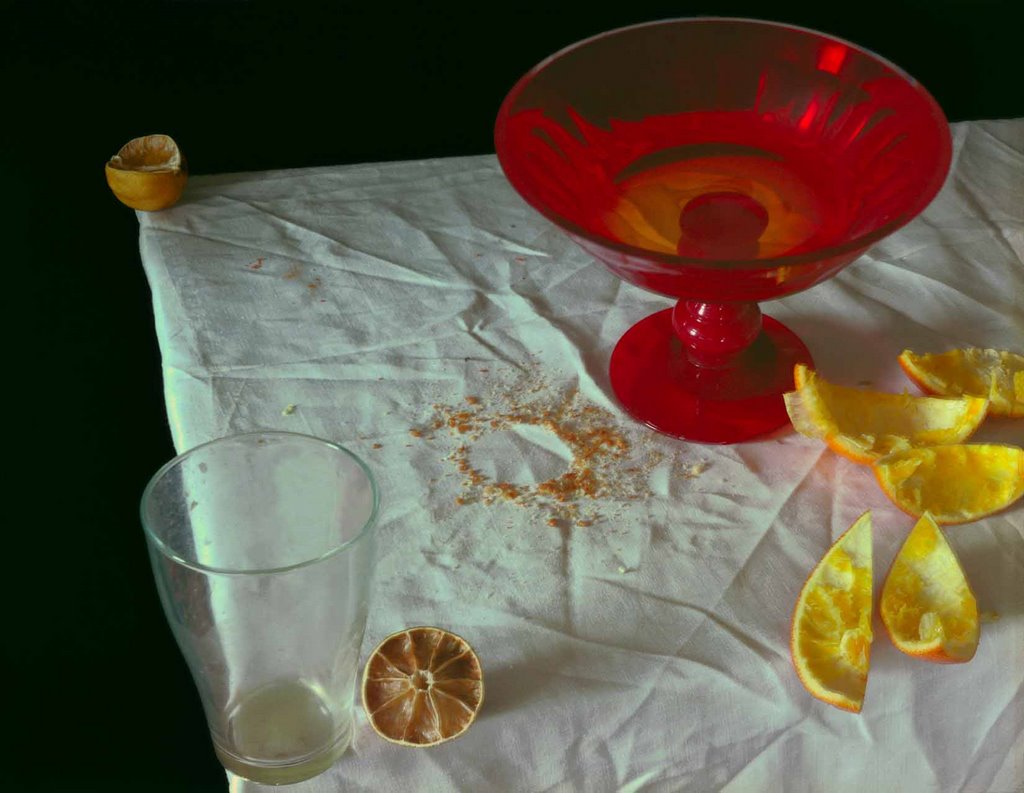
Untitled #14, 1999

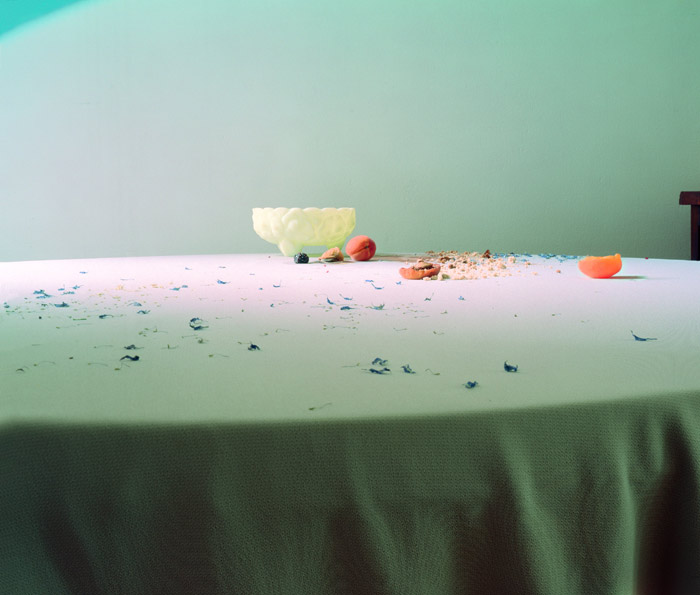
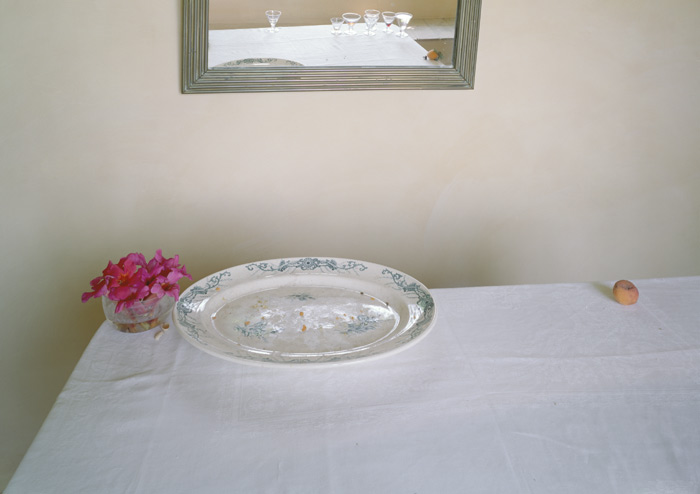
Letinsky's still life imagery “Hardly More than Ever” (1997-2004), is inspired by Dutch still life painting yet pushes the genre beyond its traditional intention. Her still lifes, taken in the morning light, are a residual record of previous gatherings, whether an intimate get-together or larger event. The leftovers become pieces of a vocabulary that construct a visual and emotive tableau distinctly human yet absent of people. Carefully arranged dirty plates, soiled linens, and crumpled napkins act as metaphors not only for the transience of personal interaction but also the fleeting cherished moments of our busy lives.


Untitled #10, 1999


Untitled #52, 2002


Untitled #80, 2003


Untitled #55, 2002


Untitled #54, 2002


Untitled #43, 2002


Untitled #92, 2004

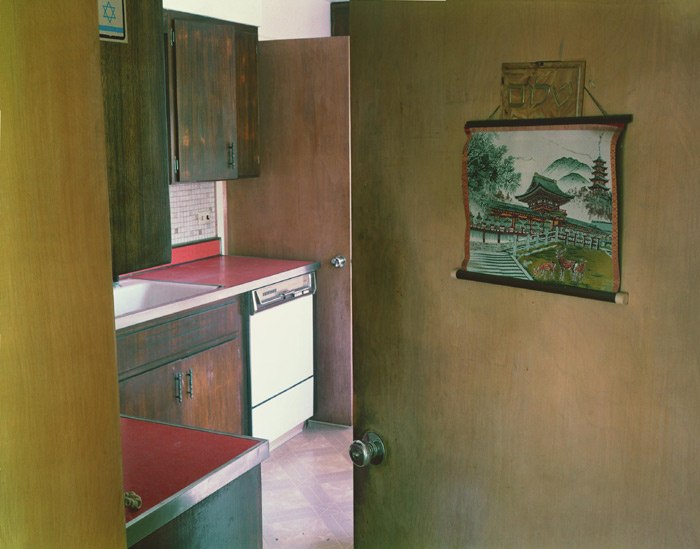
In "Somewhere, Somewhere" (2003 to the present), Letinsky photographed unfurnished rooms in temporary states of transition left with remnants of activity from a previous occupant and untouched by a new inhabitant. Through compositional elements, cropping, and light, the photographs descriptive function becomes an emotive document revealing the subtle complexity of these once intimate spaces. For example, an interior of a hallway reveals open and closed doors with mirrors and reflections that complicate the architecture. Light shines through the window and off the floor where discarded wrapping tissue sits waiting to be swept away.


Untitled #116, 2006


Untitled #111, 2005


Untitled #104, 2005

Questions-
  1. How would youdescribe Letinsky's use of color in her photographs?
  2. The author above describes Letinsky's work, writing that the objects in the photographs "act as metaphors not only for the transience of personal interaction but also the fleeting cherished moments of our busy lives." Do you agree?
  3. Do you find these photographs boring? Why, or why not?

Ch. 4- Something and Nothing- Anthony Hernandez

Anthony Hernandez has long been fascinated with the landscape. He began as a street photographer making 35 mm black and white images of people in the urban landscape. In the mid 1980's he moved from documenting the city to making color images of unpopulated places with a large format camera.

Aliso Village, east of downtown L.A., was a low-income housing complex that was built in the 1940s and torn down in 2000. It is here that Hernandez was born and raised. The Aliso Village images are haunting and empty. They include photographs of graffiti filled walls (Aliso Village 16) and brightly painted closets (Aliso Village 14). To make these images Hernandez would sneak into the buildings when the demolition crew was not there and roam around the vacant spaces. The images evoke memories of another time, when the rooms were furnished and the dwellings populated.


Aliso Village #3


Aliso Village #9


Aliso Village 16


Aliso Village 14

by Jody Zellen

Hernandez is a gifted photographer. He closes in on his subject in order to reveal its intricate details. In the series Landscapes of the Homeless, begun in 1988 and finished in 1991, he carefully documented the out of the way places the homeless retreated to. While photographing these encampments he made sure that no one was about, so as not to disrupt the life of its inhabitants. In these works Hernandez is a voyeur looking in at a community that is obviously other. Yet it is the place, not the people, that interests him.

The resulting large color photographs are aestheticized documents of the homeless' horrible living conditions. These are places built for shelter and survival. Hernandez is not out to artify his subject but rather to point out the inherent contradictions within the urban environment. To make these photographs Hernandez scouted out places where the homeless congregate. The resulting pictures document not only the ingenuity of the homeless but Hernandez' sensitivity to their plight. Viewed at a distance, the images appear to be photographs of the natural landscape. Upon close examination the details of habitation reveal themselves. The contrast between "one's expectation of beauty and the reality of homelessness" is central to the works' impact.


Landscapes for the Homeless #24, 1989


Landscapes for the Homeless #17, 1989


Landscapes for the Homeless #54, 1989


Landscapes for the Homeless #18, 1989

Questions-
  1. How does knowing Anthony Hernandez' personal history influence what you think about the Aliso Village photographs?
  2. Do you agree with Zellen, when she writes "Hernandez is not out to artify his subject but rather to point out the inherent contradictions within the urban environment?"
  3. How does the lack of any human presence effect your experience of Hernandez' images?